The relaunch post called itself the starting line rather than the finish. Since then there have been forty entries on the changelog, and what the site does has changed enough to be worth one post instead of forty.
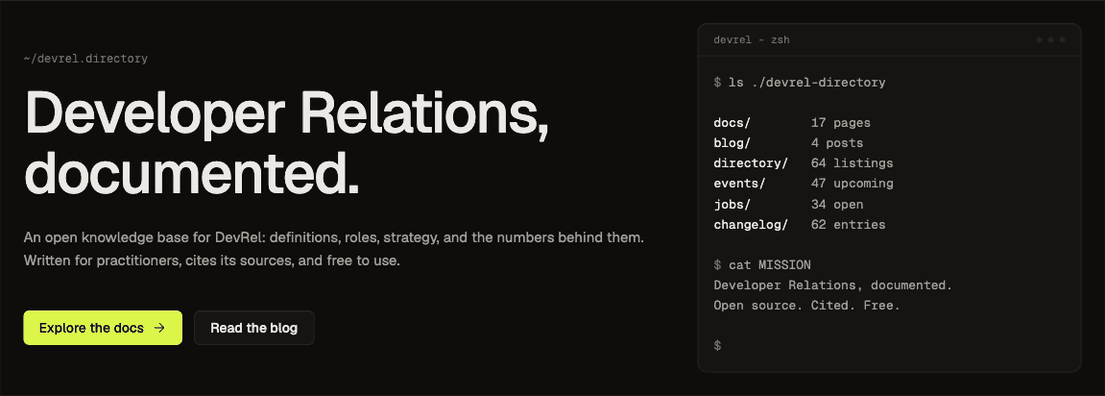
Back then it was a curated list with a jobs board attached. It is now a set of DevRel datasets that people and machines can both read: the tools and how they compare, the open roles and what they advertise, the conferences taking submissions, and the talks that came out of them.
One rule runs underneath all of it. Every checkable fact says when it was checked, and nothing is estimated. That rule is why the rest holds up, so it gets its own section at the end.
Picking a DevRel tool now has an answer
The directory used to tell you what a tool is. It could not tell you which one to use, which is the actual reason people arrive.
There are now 23 head-to-head comparisons between listings named as alternatives to each other, like GitBook vs Mintlify and Discord vs Slack, each measuring both products on identical criteria. Thirty listings have an alternatives page of their own, such as alternatives to Mintlify, where the hand-picked options come first and say so. Three stacks go the other way round: for documentation, community, and measurement, they lay out the decisions in the order you have to make them, then name the candidates for each one.
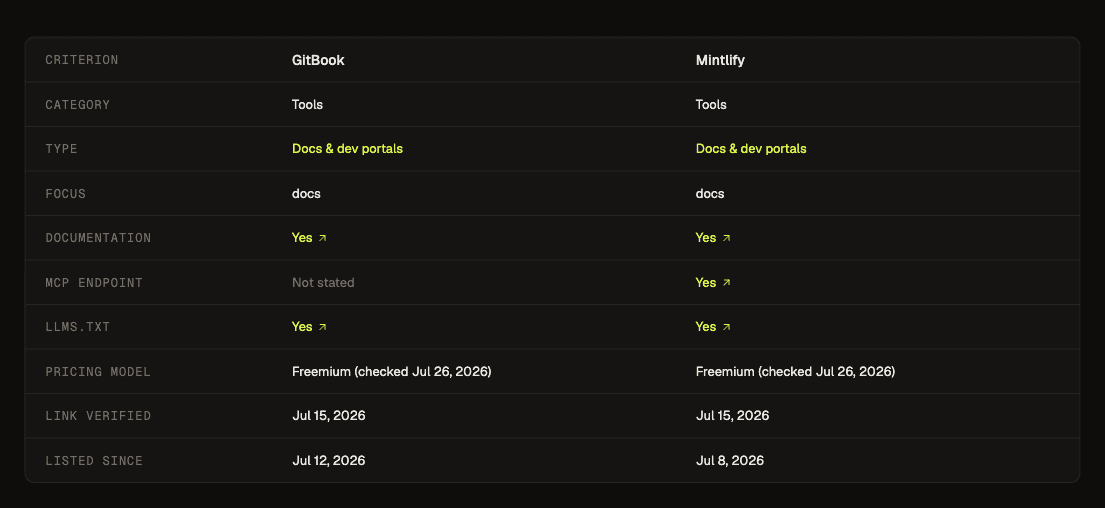
The listings themselves carry more than a description now. The tools category went from 9 entries to 46, out of 64 listings across all five categories. Where a listing points at a GitHub repository, its page shows the star count, the month of the last commit, and whether GitHub reports the repository as archived. Thirty-two of those 46 tools carry a pricing model, read off the product's own pricing page and stamped with the day it was read. The other 14 show no pricing at all, because the page could not be read or genuinely does not say, and a blank is a better answer than a guess.
These pages deliberately do not pick a winner. I do not test tools hands-on, so a comparison states what it compares and what it leaves out, and where a product publishes nothing on a criterion the table says so.
Some listings also carry a short dated note from me about where a product stands, which is how Developer Avocados Weekly can stay listed while saying plainly that its last issue was May 2024. A dormant newsletter with a good archive is still useful. Something you can no longer sign up for is not, which is why Stainless came off the list once its hosted generator started winding down and new signups closed.
DevRel salaries: what open roles advertise
The most-quoted pay figure in Developer Relations sits behind a form and dates from 2023. DevRel salary data is the free alternative, rebuilt from live job postings every day.
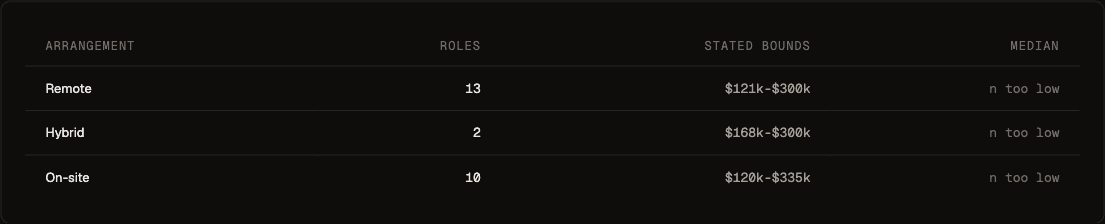
As of 30 July 2026, 25 of the 34 open roles on the jobs board disclose pay in USD. Across those, the median asking-range midpoint is $192,500, and stated bounds run from $120,000 to $335,000. All 25 ranges are published individually on a shared scale, so you can see the distribution rather than trusting one number.
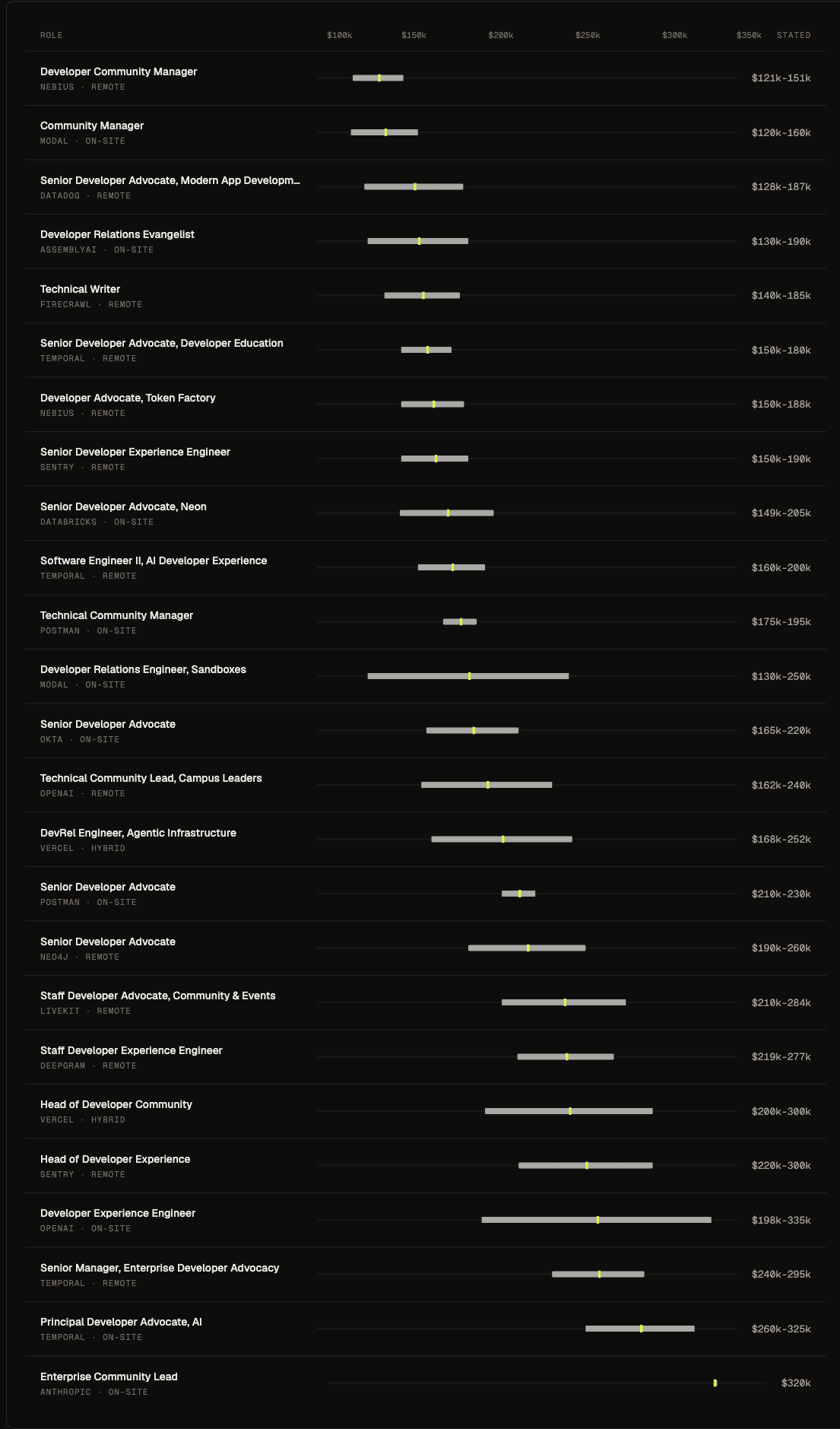
These are asking ranges, not pay. Every figure comes from a band an employer published: no accepted offers, no equity, no bonuses, nothing self-reported. Roles quoted in other currencies are left out rather than converted at a rate that would date instantly.
Below 20 disclosing roles a median is withheld outright instead of published with a caveat, which is why the remote, hybrid, and on-site cuts show stated bounds and no median. A published methodology names the five things you need to judge the figures, including the ones that make them look worse. The largest is that the sample is a watchlist of companies known to hire in DevRel rather than a census of the field, so it skews toward US-headquartered, well-funded employers.
Who hires for DevRel
Who hires for DevRel carries a page for each of the 22 employers a run has caught hiring, out of a watchlist of 34 boards read twice a week. 21 of them had something open on 30 July 2026. Once a posting comes down it stays on the company page with the date it left. A job posting tells you about one role, and a careers page only ever shows today, which is the gap that record fills. No job board I know of keeps that part, and it is what will eventually show which employers keep coming back to this function.
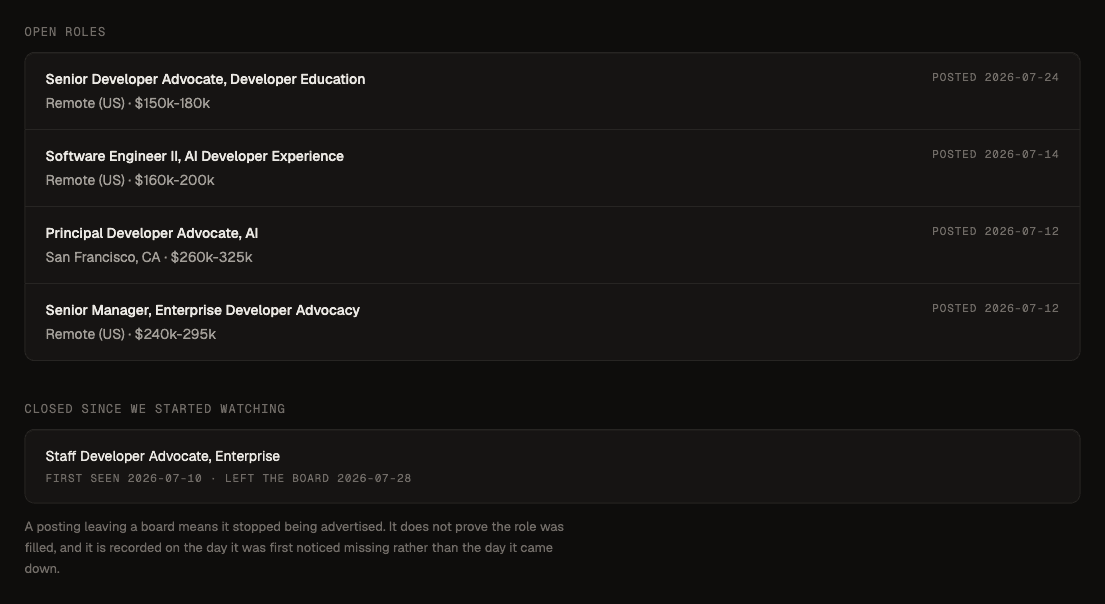
Every posting on the board also shows when a run last found it on the company's own careers page. The wording is "still listed" and never "verified open", because companies leave filled roles up for weeks and the check cannot tell the difference. A stamp older than two weeks disappears rather than sitting there going stale.
If you know a company hiring in DevRel that is not on the board, nominating it adds its careers page to the scan, so every role it posts from then on shows up rather than just the one you spotted. Nothing about who applied is recorded, ever.
Events, and what each open CFP says a speaker gets
As of 30 July 2026 there are 47 upcoming events listed and 20 open calls for papers, 9 of them closing within 30 days. Both the events page and its filters live in the URL now, so /events?cfp=open is a link you can send to someone who is looking for a stage.
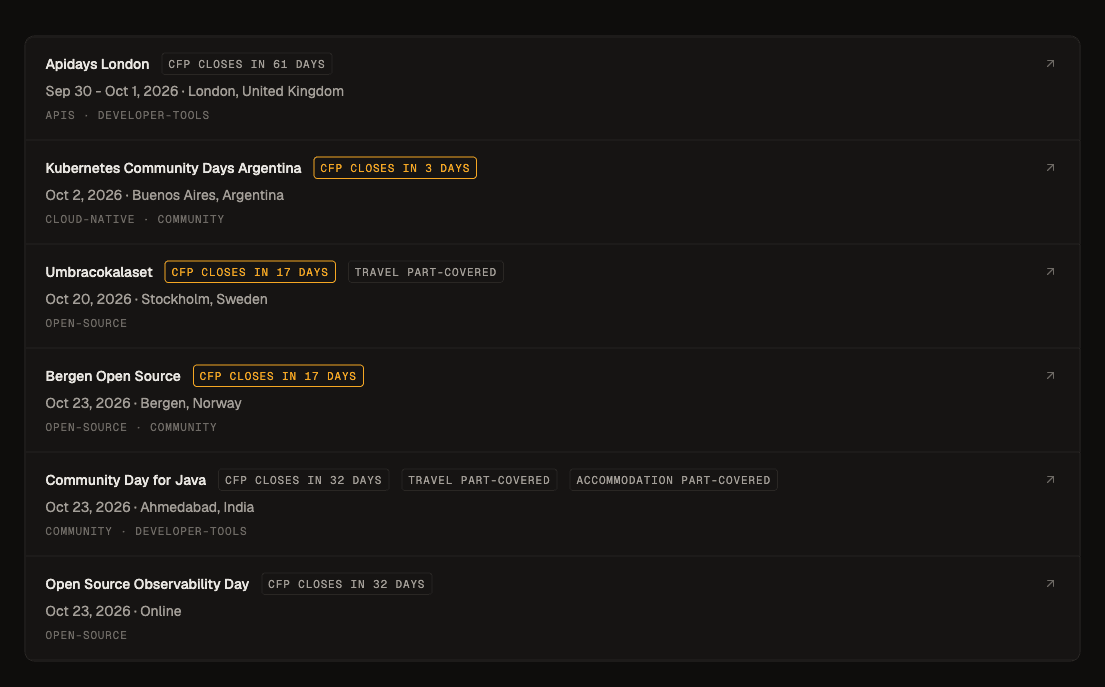
The part I am most glad exists: I read all 20 open CFP pages and wrote down what each one says a speaker gets, meaning travel, a room, and a fee. Eight of the 20 say something. The other twelve say nothing at all, and the event page says exactly that rather than leaving a gap, because "I checked and the CFP is silent" is a different answer from "nobody has looked".
Silence is the norm here rather than a warning sign. Plenty of organizers help speakers who ask and simply never wrote it on the page. Nothing is rounded up either: a travel refund capped at a limit shows as part-covered, because turning a cap into a promise is how someone ends up out of pocket.
Event pages are also permanent now. They used to vanish once the dates passed, which broke every bookmark and citation the week after the conference. Past editions keep their page as a record and link to the next edition where one is listed. There are iCal feeds for events and for CFP deadlines, the second carrying a reminder a week before each deadline.
How to get into DevRel
"How do I get into DevRel" is the question I get asked most, and I have never found one page that answers it properly. Start here is mine: a reading order through the fundamentals, the communities that are demonstrably still alive, the CFPs closing soonest, and an honest read of the job market. Honest includes the uncomfortable number. Of the 34 roles open on 30 July 2026, none are junior, and the page says so rather than implying otherwise.
The communities, newsletters, and podcasts on that page are the 11 of 12 that an automated check confirms are still reachable, each shown with the date it was last confirmed. Dead invite links are close to standard in this space.
An index of DevRel conference talks
DevRel talks holds 73 talks from two DevRelCon London editions, each checked twice against the conference's own published playlist, with runtimes shown so you can tell a keynote from a lightning talk before clicking. It indexes talks and not speakers. There is no speaker field, no speaker page, and no way to filter by person, and an automated check fails the build if anyone adds one. A conference publishes a talk under a title that usually names its speaker, so attribution stays inside the title exactly as written, and nothing here turns that into a separate record about an individual.
Built to be read by machines
The relaunch made the docs machine-readable, on the argument that a site about developer relations should be readable by the tools developers use. Everything added since holds to that, and none of it is gated.
- /llms.txt is the index, and /llms-full.txt is the full corpus: every guide, stack, comparison, listing, active job, upcoming event, and indexed talk in one Markdown file that always reflects current data.
- Seven page types have a Markdown twin. Add
.mdto the address of a docs page, a listing, a comparison, an alternatives page, a stack, /salaries.md, or /start.md. - A read-only MCP server runs at
https://devrel.directory/mcpwith six tools over the directory, jobs, events, docs, and aggregate stats. No key, no signup, and it is in the official MCP registry asdirectory.devrel/devrel-directory, so registry-backed clients can find it by name. - robots.txt names GPTBot, ClaudeBot, Claude-User, PerplexityBot, and Google-Extended with allow-all groups of their own. The only closed paths are the payment endpoints.
- Pages carry structured data describing what they are: an article, a dataset, a job posting, an event, a set of questions and answers. A page that states what it is can be quoted; a page that has to be inferred gets paraphrased.
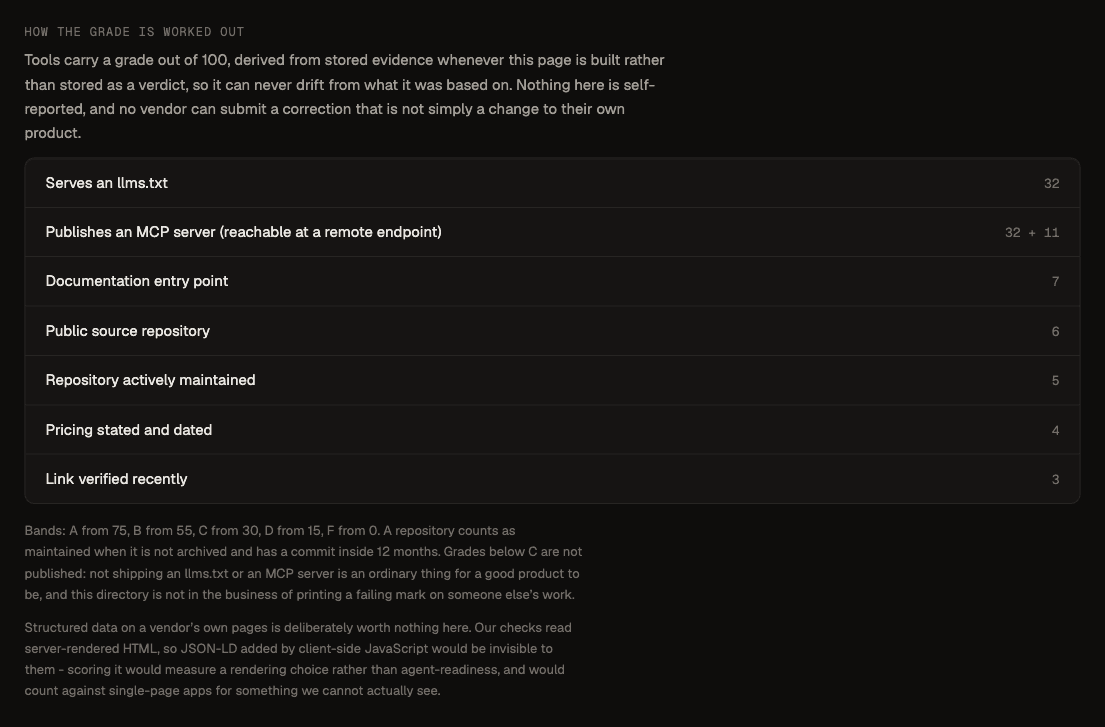
The agent-readiness grade applies the same standard outward. Tools now carry a letter for how far they have gone in this direction: a published llms.txt, a published MCP server, public documentation and source, repository activity, a dated price, a recently verified link. The full rubric sits beside the grades, every signal with its weight and every band with its cutoff, because a grade nobody can check the working of is just an opinion with a letter on it. Nothing is self-reported, and no grade is stored anywhere: each one is derived from the evidence when the page is built, so it can never describe a product as it used to be.
Grades below C are not published. Shipping no llms.txt and no MCP server is an ordinary thing for a good product to be in 2026, and a directory has no business printing a failing mark against someone else's name. Below the floor a tool shows what it always showed, with no letter.
Whether this results in the site being read and cited is something I measure rather than assume. That is a longer post once there is more than three weeks of data behind it.
Why every number carries a date
This is the rule I would keep if I had to throw the rest away.
Nothing is estimated. A salary range appears because a posting stated it, and a price because the pricing page said it. No model fills a gap, no currency is converted, and no figure is inferred from a company's size or a job title.
Every fact that can go out of date carries the day it was checked. Pricing, repository activity, CFP terms, link verification, and my own editorial notes all render with their date attached, because an undated claim is one you cannot judge and it will still get quoted a year later.
Figures below a sample threshold are withheld instead of caveated. A median over four postings is a number that will move by double digits when a fifth arrives, and putting an asterisk next to it does not fix that.
The records that matter are append-only. The pay ledger and the weekly statistics snapshot are added to and never edited, and an automated check rejects any change that would rewrite an existing row. That means the history cannot be quietly revised, including by me.
Every guide states who wrote it and when it was last confirmed accurate. Directory placement is never for sale, and paid featured job posts are excluded from the pay ledger, so no figure on this site can be bought.
None of that is difficult. It is just the difference between a directory you can cite and a wall of links that happens to rank.
What is not finished
The numbers page only just started keeping a weekly record, so its trend section holds a single row.
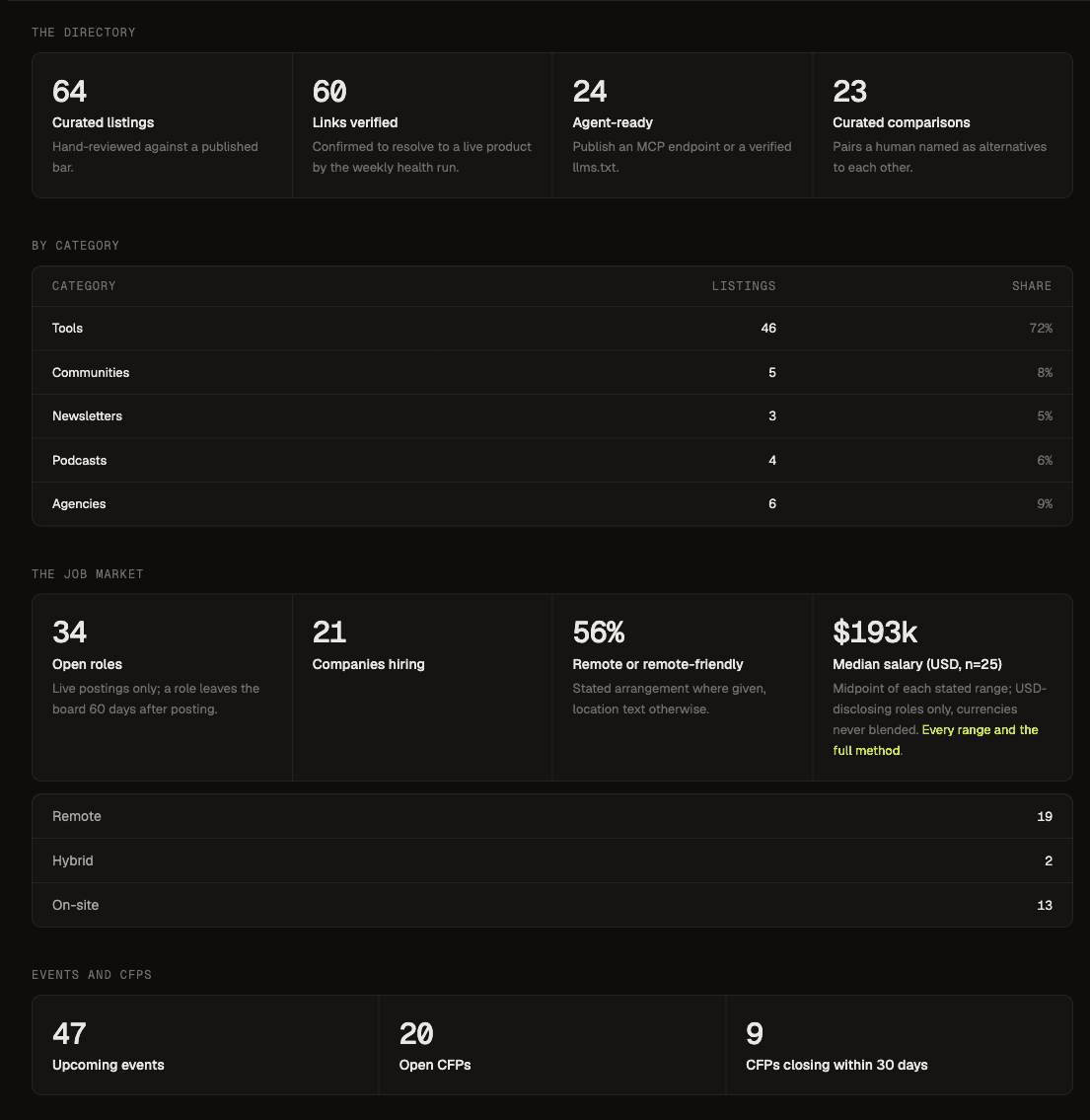
It fills in on its own, nothing gets backfilled, and comparisons wait for 90 days between two real snapshots, because at this size one company posting four roles moves the job count by a tenth.
The pay ledger holds 26 observations across 16 companies but spans fewer than 180 days, so the trailing-twelve-month section stays shut until the record is long enough to deserve the label.
The talks index covers two DevRelCon London editions. Calling that a record of DevRel talks would be generous, and it is a first pass.
The newsletter is open and goes out when there is genuinely something to send, which is not every week.
If you want in on it
- Know a tool, community, newsletter, podcast, or agency that belongs here? Submit it to the directory.
- Hiring for DevRel? Community listings are free.
- Know a company that hires in DevRel? Nominate their board and every future role shows up.
- Want it in your own tools? Point them at /llms.txt or connect the MCP server.
- Want it in your inbox or your reader? Newsletter, RSS, or the feeds for jobs, events, and listings.
The next stretch of work is mostly time rather than features. Pay history, trend lines, and which companies keep hiring are all things this site can only earn by having watched for long enough, and the record started three weeks ago. So the honest version of this post in six months is a chart, not a list.

At
July 30, 2026